Key Benefits
- Acrylic sealants are paintable after curing, allowing for a uniform finish that blends well with surrounding surfaces.
- They are easy to apply and tool for precise, clean results.
- Low odour formulation makes them suitable for indoor applications such as wall and ceiling joints, window and door frames, baseboards and more.
- When cured acrylic sealants form a flexible and durable joint.
- Certain formulations offer high temperature resistance and can be used outdoors.
These sealants offer a cost-effective solution for both professional and DIY applications. For best results, clean surfaces thoroughly before application and use masking tape to achieve clean joint lines.
Frequently Asked Questions
What are acrylic sealants used for?
An acrylic sealant is mainly used for sealing cracks, joints, and gaps in interior construction and finishing work. Typical applications include walls, ceilings, window and door frames, skirting boards, and joints between plasterboard or masonry surfaces.
Can acrylic sealants be painted over?
Yes. One of the main advantages of acrylic sealants is that they are paintable after curing, allowing for a seamless finish that blends with surrounding surfaces.
Are water-based sealants suitable for outdoor use?
Standard water-based sealants are best suited for indoor applications. Some specially formulated acrylic sealants can be used outdoors in low-movement areas, but for exterior joints exposed to significant weather or movement, silicone or hybrid sealants are usually recommended.
How long does acrylic sealant take to dry?
Drying time depends on product formulation, joint size, temperature, and humidity. Most of them skin over within 15–30 minutes and fully cure within 24 hours.
Is acrylic sealant flexible after curing?
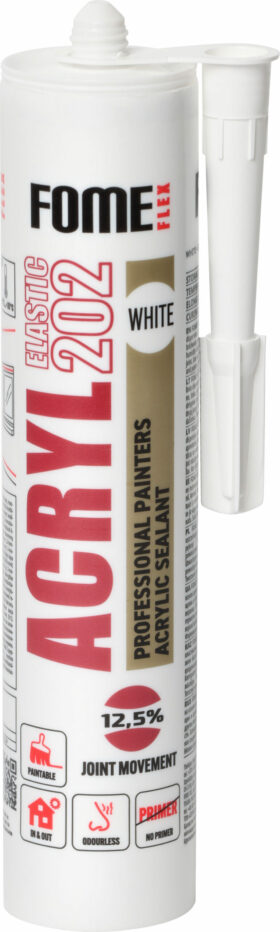
Some formulations of acrylic sealants, like FOME FLEX Wall Acryl, are flexible after curing, making them suitable for moving joints. Others offer limited flexibility, making them suitable for low-movement joints.
Can acrylic sealant be used in bathrooms or kitchens?
An acrylic sealant can be used in dry areas of kitchens and bathrooms. However, for areas exposed to constant moisture or mould risk (e.g., showers, sinks), sanitary silicone sealants are recommended.