- Complex Surface Insulation – Insulate curved, cylindrical, convex, or polygonal surfaces with uniform coverage impossible to achieve with rigid insulation boards. The expanding foam adapts to uneven substrates, filling voids and creating consistent thermal protection across challenging architectural elements.
- Attic and Roof Insulation – Apply directly to roof decking, rafters, and attic spaces to create superior thermal barriers with minimal material thickness. The airtight seal prevents heat escape through roof structures while accommodating thermal expansion without cracking or separating from substrates.
- Foundation and Basement Sealing – Protect below-grade structures from moisture infiltration and thermal loss with strong adhesion to concrete and masonry surfaces. The closed-cell structure resists water penetration while providing excellent insulation value in challenging underground environments.
- Pipe and Ductwork Protection – Insulate HVAC ductwork, water pipes, and mechanical systems against temperature loss and condensation formation. The conforming application wraps completely around cylindrical surfaces, preventing energy waste and protecting against freezing conditions.
- Window and Door Frame Insulation – Seal gaps around window installations, door frames, and penetrations where air leakage compromises energy efficiency. The controlled expansion fills cavities without distorting frames, creating weather-tight seals that reduce drafts and improve comfort.
- Renovation and Retrofit Projects – Add insulation to existing structures without extensive demolition or reconstruction. The spray application accesses tight spaces between studs, joists, and existing materials, upgrading thermal performance in occupied buildings with minimal disruption.
- Industrial Equipment Insulation – Protect tanks, vessels, and industrial equipment from temperature loss with customized thickness application. The material withstands operating temperatures from -80°C to +120°C, maintaining thermal stability across extreme industrial conditions.
- Acoustic Insulation – Reduce sound transmission through walls, ceilings, and floors with 60 dB sound attenuation properties. The dense foam structure absorbs vibrations and airborne noise, creating quieter interior environments in residential and commercial spaces.
- Mobile and Modular Construction – Insulate transportable buildings, containers, and prefabricated structures with lightweight yet highly effective thermal protection. The spray application adapts to movement and vibration without compromising insulation integrity during transport and installation.
Coverage Planning Guide: Spray Foam Insulation
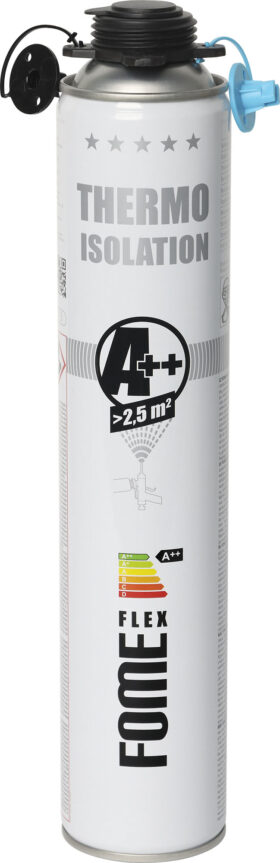
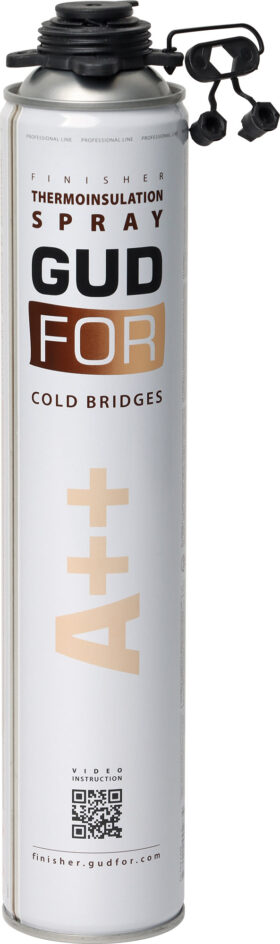
Accurate material estimation ensures complete thermal protection while controlling project costs. GUDFOR A++ and FOME FLEX THERMO ISOLATION A++ spray foams provide approximately 2.5m² coverage per 850ml canister when applied at recommended thickness. For standard thermal bridge treatment, calculate one canister per 2-3 linear meters of problematic junctions depending on surface complexity. Full wall or ceiling insulation requires multiple thin layers rather than single thick applications – plan for 2-3 passes at 2-3cm thickness each to achieve optimal R-value. Complex surfaces with deep cavities or irregular geometries may require 30-50% additional material compared to flat surface calculations. Always account for over spray and practice application, adding 20% material contingency to ensure sufficient coverage for complete project execution.
Spray Foam Application Instructions
- Surface Preparation – Clean all surfaces thoroughly, removing dust, dirt, grease, loose particles, and any contaminants that reduce adhesion. Slightly moistening substrates by light water spray improves foam expansion and surface bonding.
- Temperature Control – Store foam canisters at room temperature (+18°C to +25°C) for 12-24 hours before application. Work only when ambient temperatures range between +5°C and +30°C for optimal foam expansion and curing properties.
- Equipment Setup – Shake canister vigorously for 30 seconds before attaching to foam gun. Secure special application nozzle (blue for vertical surfaces, black for ceilings) and open gun valve completely for consistent material flow.
- Application Technique – Spray from 30-45cm distance, pressing gun trigger fully for uniform material dispensing. Apply thin layers of 2-3cm maximum thickness, building up insulation gradually rather than attempting thick single coats.
- Layer Building – Allow 20 minutes between layer applications for partial curing. Multiple thin layers provide superior adhesion and thermal performance compared to single thick applications that may crack or separate.
- Surface Finishing – Lightly mist completed insulation with water spray to enhance curing process. After 24-hour full cure time, excess foam can be cut, sanded, plastered, or painted as required for finished appearance.
Explore Tegra State’s Mounting Foam Solutions
Beyond our specialized spray insulation materials, Tegra State provides comprehensive polyurethane foam solutions for every construction requirement:
- Gun Type Mounting Foams deliver precise application for window installation, door mounting, and gap filling with professional foam guns offering adjustable flow control.
- Straw Type Mounting Foams provide convenient single-use application for smaller projects, repairs, and installations requiring no specialized equipment investment.
- Foam Glue combines adhesive properties with insulation performance for rapid installation of insulation panels, blocks, and construction materials.
- Tools and Accessories include professional foam guns, cleaners, and application equipment ensuring optimal results across all mounting foam applications.