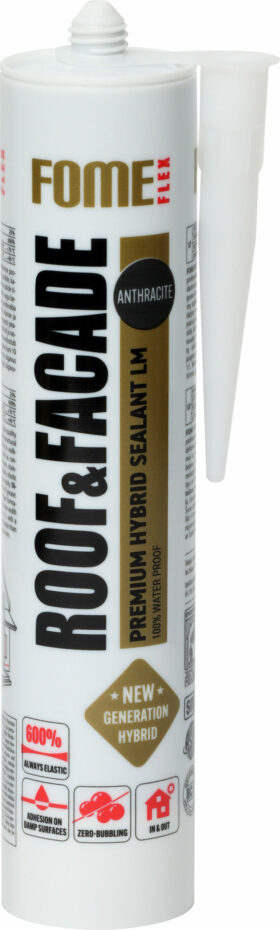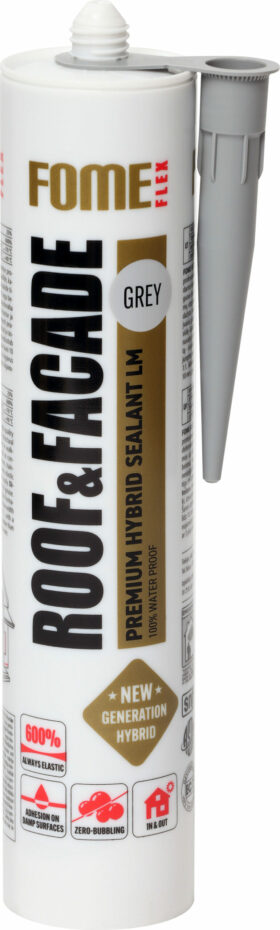
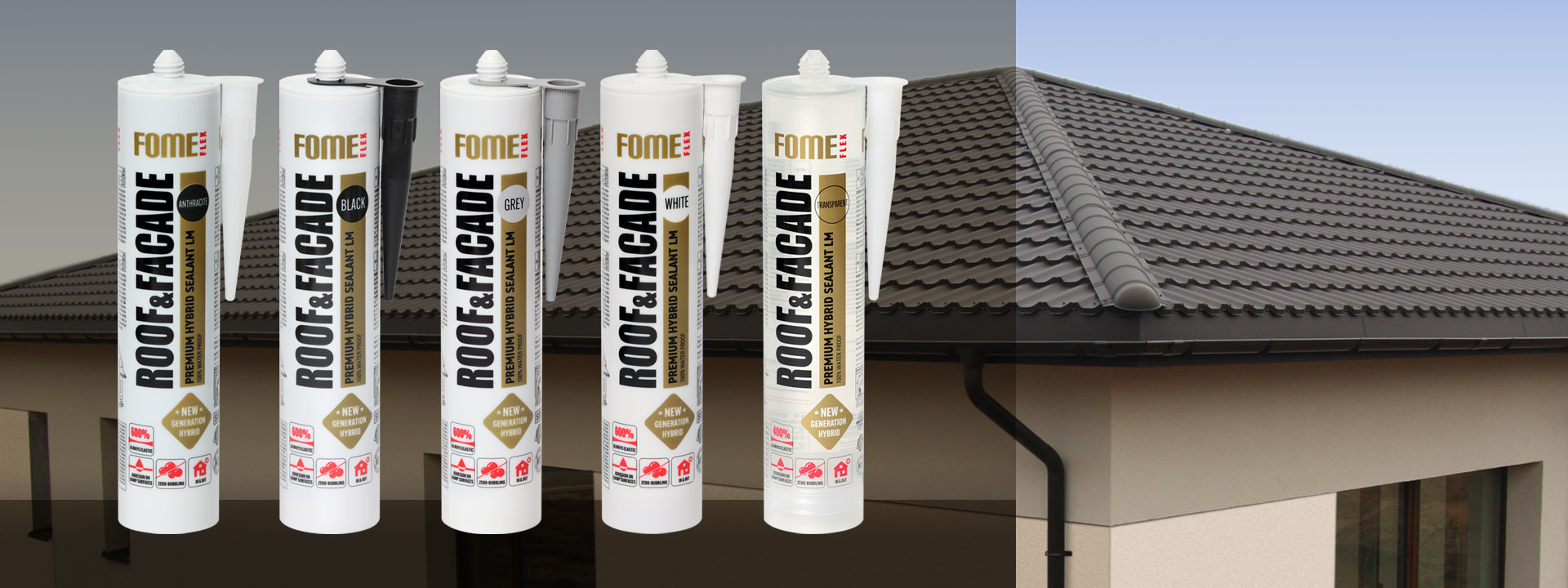
A common challenge for builders during construction work is how to reliably seal structural and expansion joints in facades, roofs or walkways. We offer a professional, high-quality and advanced solution – Fome Flex ROOF & FAÇADE sealant. A new generation, low modulus hybrid façade and roof sealant forms an extremely elastic and durable seam on commonly used building materials. Learn more about the technology behind Fome Flex ROOF & FAÇADE and why it is unrivaled in the market.
“Fome Flex ROOF & FAÇADE” is our next-generation hybrid sealant featuring advanced and innovative technology based on a revolutionary principle.
Enhanced Durability and Environmental Compatibility
Hybrid sealants cure with moisture in the air and they are designed to be more elastic and mechanically more durable than traditional products. “Fome Flex ROOF & FAÇADE” is also more resistant to temperature and weather fluctuations, resulting in a longer service life. It is also completely environmentally and health friendly, and is almost odorless.
These hybrid sealants are unique not only in their properties, but also in their versatility. They seal structural and expansion joints in facades, roofs and walkways on commonly used building materials. “Fome Flex ROOF & FAÇADE” is therefore the perfect choice for concrete, brickwork, painted wood, enamel, aluminum, stainless steel and various plastic surfaces.
Superior Performance Characteristics for Professional Results
By forming a highly elastic and durable seam on these materials, hybrid sealants cure without bubbles. They are also free of isocyanates, solvents and silicones, suitable for wider joints, with high mechanical resistance and strong initial adhesion.
“Fome Flex ROOF & FAÇADE” is also unique due to its zero settling. This product has excellent primer-free adhesion to most surfaces, even wet ones. Hybrid sealants are easy to apply and have a cure rate of 2-3 mm per day.
Comprehensive Step-by-Step Application Guidelines
Follow these steps for optimal results when applying the product:
1. Surface preparation:
Clean and degrease all surfaces thoroughly to ensure strong adhesion.
2. Cartridge setup:
Cut off the top of the cartridge or foil pack and attach the supplied nozzle securely.
3. Loading the applicator:
Insert the cartridge or foil pack into the dispensing gun.
Squeeze the trigger several times to fill the nozzle with sealant.
4. Application:
Apply the sealant evenly along the joint or seam, maintaining steady pressure for a uniform bead.
5. Recommended joint dimensions:
- For seams up to 10 mm wide: maintain a 1:1 depth-to-width ratio (minimum 5 mm each).
- For joints wider than 10 mm: calculate depth as (width ÷ 3) + 6 mm.
- The maximum joint width should not exceed 40 mm.
We are offering five different hybrid sealants in its range. “Fome Flex ROOF & FAÇADE” is available in clear, white, grey, black and anthracite.
All these products are certified with CE certification and other important certifications recognized in the construction market:

For these reasons, “Fome Flex HYBRID ROOF&FAÇADE” is unrivalled in the market as a new-generation, low-modulus, premium hybrid sealant. For those who are looking for a reliable, high quality and intelligent joint sealing solution, this product will exceed all expectations.
Frequently Asked Questions
Silicone and hybrid sealants (such as MS polymer or STPU) are ideal due to their superior flexibility, UV resistance, and durability in harsh weather conditions.
Yes, applying a roof sealant helps extend the lifespan of the roof, prevents leaks, and reduces ongoing maintenance expenses.
Yes, when properly applied, roof sealants effectively seal leaks and prevent water penetration.
Roof cement is a thicker, asphalt-based material primarily used for patching. Roof sealant, by contrast, is more elastic and flexible, designed to seal joints and cracks.
Drying time typically ranges from 24 to 48 hours, depending on the sealant type, application thickness, and weather conditions.
High-quality roof sealants can last between 10 and 20 years, depending on environmental exposure and the materials used.
Begin by cleaning the surface thoroughly. Apply primer if required, then use a caulking gun to fill joints with sealant, and smooth the material with an appropriate tool.
For uncured sealant, use mineral spirits or a citrus-based cleaner. For cured sealant, mechanical removal may be necessary.
Hybrid sealants combine the elasticity of silicone with the strong adhesion and paintability of polyurethane, providing enhanced weather resistance.
Yes, if the product is specifically rated for both applications—such as Fome Flex ROOF & FAÇADE or similar hybrid sealants.
It provides excellent resistance to UV rays, rain, and temperature fluctuations, making it well-suited for year-round exterior use.
Yes, it is specifically formulated for use on flat and felt roofing surfaces, providing durable and reliable sealing.
Conduct annual inspections, clean the joints, remove any damaged or deteriorated sealant, and reapply as needed to address any cracks or gaps.
Recommended products
-

FOME FLEX ROOF&FACADE Professional Hybrid Sealant, Anthracite, 300 ml
-
FOME FLEX ROOF&FACADE Professional Hybrid Sealant, Black, 300 ml
-
FOME FLEX ROOF&FACADE Professional Hybrid Sealant, Grey, 300 ml
-
FOME FLEX ROOF&FACADE Professional Hybrid Sealant, Transparent, 300 ml
-
FOME FLEX ROOF&FACADE Professional Hybrid Sealant, White, 300 ml